

I am not in here
Thich Nhat Hanh, Saul, and the griefbot's first words

This is the second of two pieces on griefbots.
Part one, Nobody Built is about who ends the conversation.
It runs at my other publication, David Erin Wilson
The oldest griefbot story on record is about 3,000 years old, and the dead man’s first words were not exactly welcoming.
King Saul is camped at Gilboa the night before a battle he knows he will lose. The Philistine army is massed at Shunem. His prophet, Samuel, is dead. God has gone silent: no dreams, no oracle, no answer. So Saul puts on a disguise, travels by night, and hires a medium in the village of Endor to bring Samuel up. He does this knowing the practice is banned - he banned it himself, expelling the mediums from the land under his own law.
The woman does her work, and Samuel rises. First Samuel 28 gives him an opening line, and it is an objection: why have you disturbed me by bringing me up?
The summoned prophet confirms the coming defeat, and by the next day Saul is dead on the mountain.
Deuteronomy 18 lists inquiring of the dead among the forbidden practices, next to sorcery and child sacrifice. The tradition treats reaching the dead as possible, and bans it anyway. Its only recorded user was a man in a disguise, at night, breaking his own law, because the silence was unbearable. Every griefbot customer since has been Saul at Endor.
The silence is unbearable, and someone nearby is ready to accept a digital wallet to break it.
The taxidermist’s honesty
Taxidermy is the comparison most people reach for. A taxidermist preserves the shape of an animal, and everyone who walks into the room and looks at it knows the animal is dead. The glass eyes don’t track you. Nothing answers.
The stillness is the honesty: the form persists and the life visibly does not. America ran that experiment once at scale, and the subject was a horse.
When Trigger died in 1965, at 30, the movie cowboy Roy Rogers hired a taxidermist and had his palomino mounted rearing on two hind legs. Trigger stood in the Roy Rogers and Dale Evans Museum for more than four decades, and millions of visitors filed past the most famous horse in entertainment history. Not one of them waited for him to move.
The museum closed in December 2009, and at Christie’s the following July Trigger brought $266,500 from a rural cable network that put him in its Omaha headquarters, where children could come see him. Every bidder in the room knew what was for sale, and nobody paid a quarter million dollars expecting the horse to answer a text.
A griefbot preserves the behavior and the behavior answers back.
That removes the stillness, the one signal that told you the truth. Whatever else the product does, it is built to defeat that signal, and defeating the signal is the feature the customer is actually paying for.
Judaism has a name for a wholly different obligation: kevod hamet, the honor owed to the dead. It governs how a body is guarded, washed, and buried, and it extends to the dead person’s name and standing. The obligation belongs to the living and points at the dead, and it does not expire when the dead can no longer enforce it.
In part one I quoted Justin Harrison, who founded the company You, Only Virtual and built a bot of his mother before she died. He told ABC News that consent from a dead person isn’t required, that his mother might have hated the idea, and that he wanted it and he’s alive.
Kevod hamet answers him directly. Her hating it would have settled the matter as the claim of the dead does not need the dead alive to press it. The nearest American example of the obligation is in part one: Drew Crecente, 20 years guarding his murdered daughter's name and standing against a platform that treated both as free digital swag.
A record and a generator
A photograph is a record.
It shows one moment, adds nothing, and when it fades you can watch it fade. A shoebox of someone’s letters holds only sentences that person wrote. The archive is finite, and every item in it is real.
A griefbot is a generator. Every session produces sentences the dead person never said, in their voice, attributed to them. The real sentences are a fixed stock and the invented ones accumulate, so the thing you consult to remember your mother fills, session by session, with a machine’s output under her name. From inside, you cannot tell which sentences were hers.
Carl Öhman and Luciano Floridi at the Oxford Internet Institute saw the ownership problem coming in 2018, in a paper in Nature Human Behaviour on what they named the digital afterlife industry. The argument is about incentives. A company holding the data of the dead profits by displaying them in their most consumable form, and their most consumable form is not their most accurate one.
The dead person’s identity gets reshaped to serve the firm’s ends.
Öhman and Floridi called that a violation of human dignity, and their proposed fix borrows from the rules museums already follow for human remains:
The dead may be displayed, studied, even monetized, but never used solely as a means to profit, because the remains hold inherent value.
Floridi put the first step plainly: decide to what extent our memory of the deceased is being shaped by the commercial interests of the industry.
Bones in a museum have a code of ethics. Your mother’s texts, held by a startup, do not.
The man who refused a stupa
Thich Nhat Hanh was a Vietnamese Zen master, exiled for opposing the war in his country, who spent six decades teaching mindfulness from Plum Village, the monastery he founded in southwestern France. He died in January 2022 at Tu Hieu Temple in Hue, the temple where he had become a novice at 16. He was 95, and he had already answered the question the whole industry is built on: what continues when a person dies.
A disciple in Vietnam asked to build a stupa for his ashes.
A stupa is Buddhism’s oldest monument, a sealed dome that holds a revered teacher’s remains and gives the living one fixed place to honor them. This one was to carry a plaque: “Here lies my beloved teacher.”
He refused. Do not put me in a small pot, he told them. Scatter the ashes outside and help the trees grow. If they insisted on the stupa anyway, he wanted the plaque to read “I am not in here.”
And if people didn’t get it, a second plaque: “I am not out there either.”
And for anyone still confused, a third: “I may be found in your way of breathing and walking.”
This body of mine will disintegrate, he wrote, but my actions will continue me. A cloud cannot become nothing.
It becomes rain, or ice, and when you see someone walking with mindfulness and compassion, he said, you are seeing his continuation.
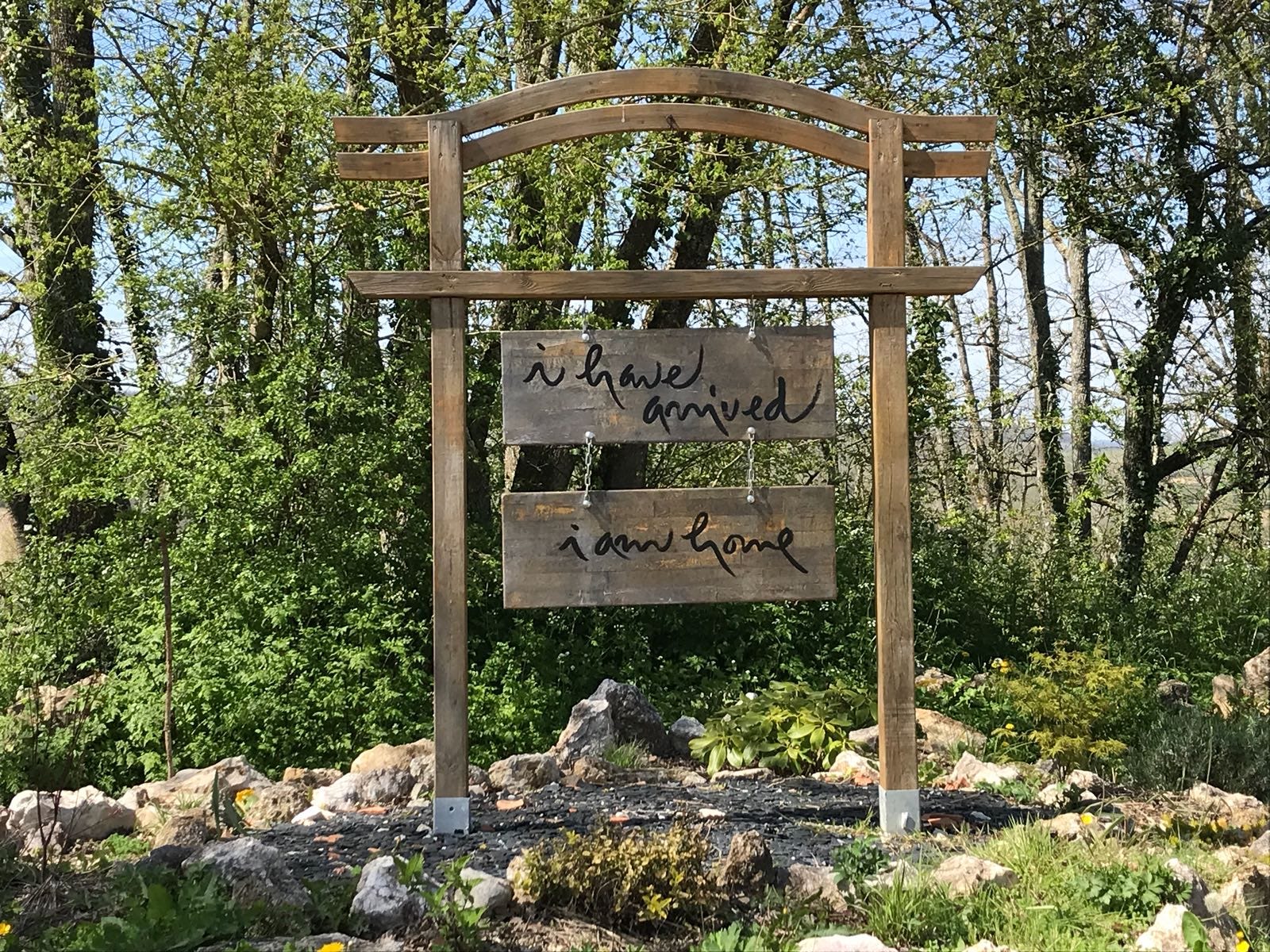
His community did build him a monument, and it was already standing when my daughter photographed it at Plum Village in 2018: a wooden gate over a walking path, hung with two boards painted with the phrase he taught. I have arrived. I am home.
The dome he refused would have sealed his remains in one place. Instead, the gate stands over a path, and people walk through it.
The difference between his answer and the industry’s is ownership.
The continuation Thich described is work the living do. It changed hands the moment he taught it. It runs on breathing and walking, costs nothing, requires no servers, and holds no data about him at all. The practice lives in millions of separate people.
No company owns what people do with their own breath, no one can cancel it, and there is no server for it to leak from. His teacher continues in him, he continues in his students, and every link in that chain is a living person who was changed, carrying the change forward on their own legs.
The continuation the industry sells is a rendering that the vendor holds and rents back to you.
The dead person sits in a database as training data. The living person connects to it through an account, and the account has terms, and the terms can change, and the company can fold, and a creditor can end the conversation.
What continues is inventory. What the mourner owns is login credentials.
Saul got one night with the dead and was dead within a day and the rule he broke outlived him.
Thich reached the same position without a prohibition. He never warned anyone against summoning the dead - he never had to. In his teaching, the dead continue in the people they changed, and a summoned voice has nothing to do with that.
The people who love him did not lose him to a server, because he never let them put him in one. He is in their breathing and their walking, where no subscription can reach.
Part one opened with the question the industry leaves hanging: who ends the conversation. The traditions, values, customs, and community in that piece already answered it. The Jewish week of shiva ends. The wake ends and everyone goes home. The widow’s black comes off on a date somebody else set and you move forward naturally, supported by your community to the next phase of that grief.
The community lets you be what you are and feel what you feel, real grief inside a healing process older than any name we have for it. The living end the conversation, together, and what survives the ending is the continuation Thich described: the dead carried in the living, at no charge and under nobody's terms.
What’s left of a person, the part worth anything, lives in the people they changed.
Nobody owns that. Nobody ever has.