

Empty Desks
Four companies, four fates, one meteor. The AI field is lining up for the same impact.

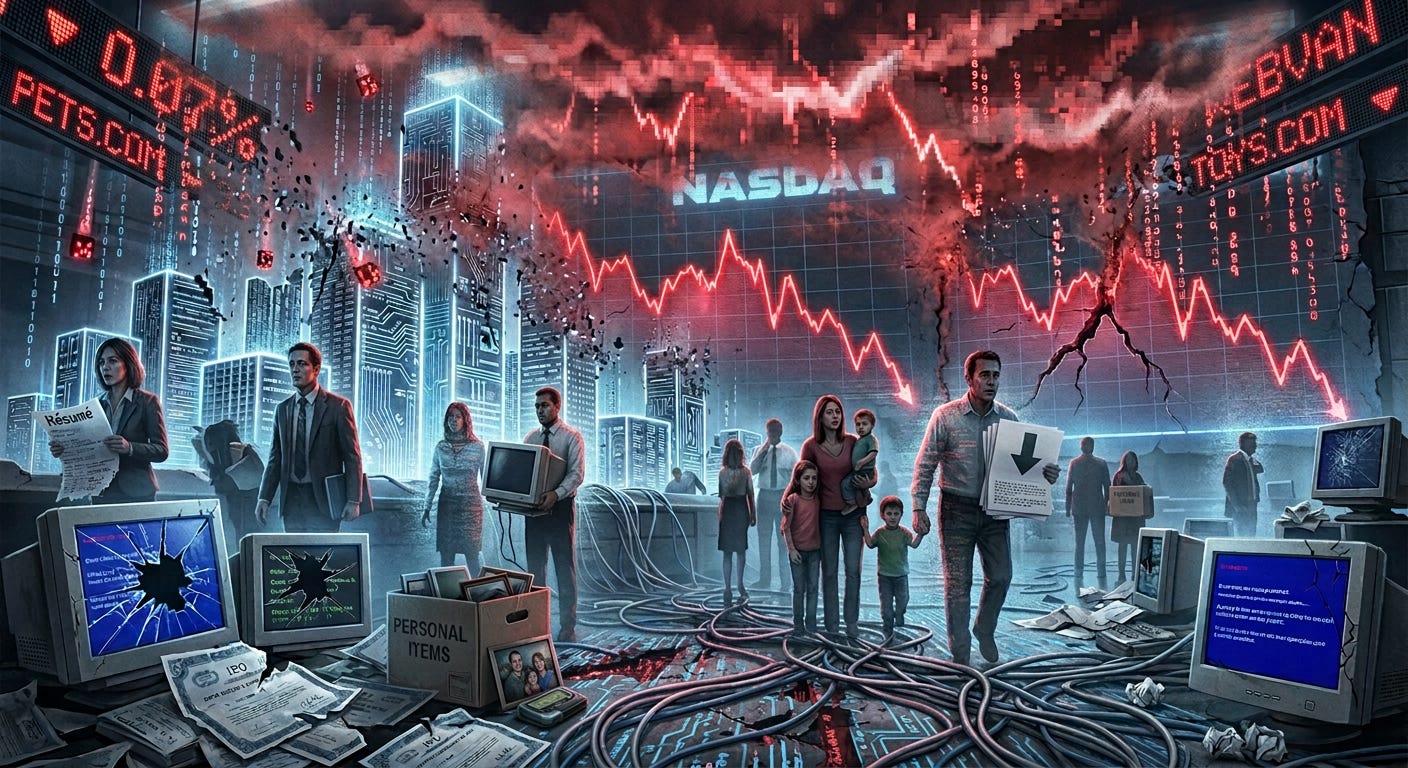
I was inside four companies that met the dotcom crash the way the Andrea Gail met the storm in The Perfect Storm, a Gloucester boat in a movie that opened in June 2000, the same summer the market went under.
Unlike the swordboat, the four companies each got a different ending. One got absorbed. One went extinct. One adapted. One ate everything in sight and then got eaten
A quarter century later, the Dotconomy veterans I know are all noticing the same thing. The AI buildout is producing the same rooms and the same option math.
Option math is Schrodinger’s compensation. Your grant is simultaneously a fortune and a punchline, and the state collapses fresh every time you check. In 2000 we checked hourly.
One piece of period machinery sat underneath all four stories and hundreds more.
The market-cap projection did the raising: a forward estimate of what a company would be worth, future stock price times expected shares, real money raised today against a valuation that had not happened yet. The outcome was that a company did not need a product to be valued, bought, and sold.
The Dotconomy ran on vaporware.
The people running the vaporware were young, smart, and new at it: engineering founders more than business builders, some of whom had never faced a customer, and few of whom wrote anything down. The whole apparatus clung to them like lampreys to a shark: the Market, the VCs, the analysts and the influencers before we had a word for them.
Start with the room I remember best.
Absorbed: ATG
Art Technology Group was a real company. Cambridge software, an e-commerce platform that major retailers actually ran, revenue that went from $32.1 million in 1999 to $163.3 million in 2000. A five-x year.
Their first dress code was: Wear shoes in winter.
The Spend flew like the curve would never bend, and the purest proof, as it often was for every doctom at some point, the ATG User Conference Paris, 2000. ATG had sunk millions into its 2000 user conference with swag, dinners, first-class travel, gifts and parties all booked, and somewhere in the run-up the question of calling the whole thing off actually came up. Bolt-on governence or OMG financial realization. Too much had already been spent.
It went ahead. Sales meetings by day, nights like a party at Caligula’s Parisian villa with no budget, and everyone checking the stock price on a BlackBerry in between. The founders were worth about a billion dollars each on paper, a figure that moved day to day with the ticker.
Back home, a recruiting department of about thirty people, internal and full time, hired as fast as the reqs could clear, a large, long blackboard on the backwall keeping score.
I came in after the first stock split, employee #88 with options struck at $48 a share. A stock only splits when the market has already decided it is going up. I arrived on that signal, at the price it produced.
Then one day the desks started emptying.
I should point out there were two screens being watched at that time and through the slide, almost nobody in the building was watching the company. The company was still shipping. But on the Blackberry screen, people were watching their own portfolios go down by the hour.
There was a second screen worth watching. Through the same stretch, the executives were selling. Stock went out by the millions in the windows when insiders were cleared to sell, every sale legal and disclosed on the required schedule, the rats jumping fiscally overboard while the rest of the building sat on options that were underwater and sinking like pre-plastered wallpaper.
And the official record shows why the room felt that way.
By October 2001, as part of the layoff ATG cut 160 jobs, a fifth of the company. It reported a $9 million quarterly loss where there had been a $5 million profit the year before, on revenue down 35 percent. Restructuring charges for 2001 alone came to $75.6 million, more than double a quarter’s revenue.
The irony of layoff day: The stock closed at $1.70, and it rose 20 cents on the news.
If you hold those two numbers next to each other, a $48 strike and a $1.70 print is not options being down, that is options being GONE with no recovery on any horizon that pays them off. Every person at those desks could do the arithmetic, and the arithmetic came out the same no matter what the quarterly results and the C-Suite said.
And we wonder why nobody read the earnings release. (ok, here is what the earnings release said anyway): Thirty million dollars still came in that quarter. The company told the market it would be profitable again within a year and would finish 2002 with more than $50 million in cash, and it was not bluffing.
It cut to survivable size, kept the product, kept the customers, and spent nine unfashionable years rebuilding, most of them under Bob Burke, a Digital Equipment veteran who ran the turnaround through to the sale. In November 2010, Oracle paid $6.00 a share, about a billion dollars, because e-commerce was a gap in Oracle’s product line and ATG’s platform filled it.
The value was real, so the value survived. The independence did not, and neither did the option math that had hired all those recruiters.
Anecdotal Note:
As Director of Inside Sales, we ran an open house recruitment event and I invited some of the best salespeople I knew who happened to come from the Legal Publishing industry. The best damn customer-experience based engagement people I’ve ever known.
The Young Turk Tech Sales Reps scoffed, ‘how can theses book salesfolks even touch ATG Dynamo?’.
In the end, after the Oracle $1B purchase, the last two original ATG salespeople left standing were my legal publishing folks.
Extinct: Opus360
Before ATG, I had already lived the faster version.
In late 1999 I was running call center operations at Opus360, the company behind FreeAgent.com.
The pitch was free agency as the future of work: an exchange matching independent consultants with companies buying project help, more than 32,000 registered consultants by the time we went public.
My team built the member services center from nothing in about six months. New building, new machines, new telephony and infrastructure… GoldMine CRM, computer-telephony integration, a Nortel Meridian PBX.
The phones were live for the IPO.
The IPO raised $77 million, 7.7 million shares at $10.00, and it priced on April 7, 2000. The Nasdaq had peaked on March 10. Twenty-eight days separated the top of the market from our first trade, and nobody inside could feel it yet.
Then, the layoffs came fast, mine included, and by July 31, 2001 the company was gone as an independent entity, reverse merged into Artemis. Fifteen months, IPO to disappearance.
The timing was fatal but tht alone did not sink the ship. Instead, within a year of the IPO came a securities class action. And there was a smaller item that tells you even more: stock options issued to FreeAgent employees that may never have been registered the way securities law requires, cleaned up later for about $100,000.
Small money. The kind of miss that shows the checking function had fallen behind the burn rate. Bolt-on governence.
Intersting, nothing about the thesis was wrong. The gig platforms built exactly this business a decade later and made it enormous. Opus360 had the right idea, a boom-time burn rate, and governance still being assembled while the market turned. Being right about the future turned out not to be a defense.
The idea outlived the company by twenty years and counting.
Adapted: the paper route
Newspapers were supposed to be the prey in this era, and the numbers agreed.
Help-wanted classifieds brought the industry $8.71 billion in 2000. Classifieds overall ran about 40 percent of newspaper ad revenue, and that margin is what kept subscriptions for you and me, cheap. For the newspaper industry, the reader was never the real customer. The advertiser was.
By 2002, help-wanted had fallen to $4.38 billion. By 2011 it was $743 million, less than Monster and CareerBuilder booked between them, and lower in inflation-adjusted terms than 1977.
Publishing took that hit but it did not cave. It went hybrid and absorbed the shocks in order: the crash, then 9/11, then 2008. I had my own eleven months on the bench in there, mid-2001 into 2002, so I take the survival part personally.
I knew the bycycle-to-doorstep delivery interface end of this business before any other part of it from age 12. Decades later I saw the distribution side at industrial scale at PCF, Publishers Circulation Fulfillment, the operation that put the Globe and the Times on doorsteps around Boston, more than a million papers a day at its peak.
What was that boring delivery layer actually worth?
January 2016 answered in public. The Globe moved its home delivery from PCF to a cheaper vendor, ACI Media Group, and flipped the switch overnight on December 28.
Within days, tens of thousands of papers were going undelivered. About 150 routes had no driver at all.
The new routing software drew routes that made no sense to anyone who had ever thrown a paper onto a porch. Two thousand subscribers cancelled in the first stretch.
Globe reporters ended up hand-delivering their own Sunday editions.
The CEO conceded that an overnight cutover was ‘more disruptive’ than anyone had imagined, which is what an executive says when an operating model was assumed instead of tested, and not a peep of governence.
Within two weeks the Globe handed half the routes back to PCF. Within a few months, all of them. The company the Globe had priced as a commodity turned out to be what actually got the paper onto the doorstep every morning.
Without the drivers and the routes, a newspaper is a website with a $10 million printing press.
Predator to Prey: Monster
Monster spent the late nineties and early 2000s eating the classifieds column alive. Then it did the thing evolution predicts but very few business books do. It partnered with the prey.
I ran the first 57 partner engagement and integration meetings of Monster’s newspaper alliance program, all of them inside six months, three of those months on the road, often two or three states in the same week.
Papers that had watched Monster drain their help-wanted revenue sat down and did the deal anyway, because keeping a share of a shrinking market beats keeping your pride. When I checked recently, the Media Alliances group listed more than 200 newspaper partners but cannot speak to it’s current activity.
For part of that stretch I was also working the other side of the story at PCF. Same years, both worlds: the company that had gutted newspaper economics, and the company that physically delivered the newspapers.
Nobody planning a career would design that overlap, but as 20/20 understanding what happened to this ecosystem, I could not have designed it better.
The papers ran the same keep-them-closer play from their own side. Tribune and Knight Ridder built up CareerBuilder as the industry’s counterweight, with Gannett joining later. So by the mid-2000s, the two apex job boards were partly owned by, and partly partnered with, the industry they had been eating.
None of it saved the predators from the next wave however.
In September 2024, Monster and CareerBuilder merged, a defensive combination between two companies the market had already forgotten about. Nine months later, on June 24, 2025, the merged company filed Chapter 11 with $2.2 million in cash against roughly $400 million in funded debt.
The job boards that once out-earned the entire American newspaper help-wanted market sold at auction for $28 million. About $930 million in private equity investment went ‘pop’.
The court filings gave the cause of death. The company had failed to keep pace with AI-driven hiring tools and job aggregators.
Decoded:
Indeed made job listings free to search and effectively infinite, which killed the paid slot Monster sold. LinkedIn turned the resume database, the asset recruiters paid Monster to search, into profiles that update themselves.
And matching moved inside the employer’s own hiring stack, where human-created AI screens rank applicants on arrival, and human programmed ATS systems exclude specified candidates leaving a destination job board with nothing left to sell on either side of the transaction.
The predator’s own obituary names AI as the thing that ate it, and the AI that ate it is the perfected form of Monster’s founding idea, matching people to jobs at scale. I do not have to argue the bridge from that era to this one. It is in the docket.
Eating the incumbents does not exempt you from becoming one.
The same sort, running now
So run today’s AI field through the four slots. Skip the argument about whether it is a bubble. Ask instead which ending each company is built for.
The ATGs have real product, real revenue, and a cost structure priced for a raise that never stops arriving. They will not vanish. They will lose their independence, and their employees’ option math, and resurface inside something larger with a logo change.
The Opus360s have a thesis, a burn rate, and a governance function still being assembled. Some of the theses are correct. It will not matter. The market picks the turn date. The paperwork is the only part they choose.
The adapters are the unfashionable incumbents quietly going hybrid right now, the way publishing did. Count on them to take the shocks in order and still be standing, with almost nobody writing it up.
And somewhere in today’s field, a company is doing to an incumbent what Monster did to the classifieds, too busy counting that revenue to ask who is building the cheaper, automatic version of its own product. Right behind them.
I think we know how that movie ends.
This will not stay inside tech either by the way.
It did not last time. Power companies are building plants for data-center demand that so far lives mostly in forecasts, forecasts big enough to power tens of millions of homes. The landlords carry the same bet a step further: buildings leased to one tenant and nearly impossible to repurpose if that tenant leaves. A few chipmakers live or die on whether one customer keeps spending.
The help-wanted money left the papers, print runs shrank, and delivery routes consolidated out from under drivers who never owned a single share of tech stock.
It reached the barstools too. I lived in Hopkinton MA in those years, EMC’s hometown, and a favorite watering hole was a Mexican restaurant with a parking lot full of Ferraris, Lamborghinis, and Porsches.
One day the cars disappeared. Then the restaurant. South Street became a ghost boulevard of lost fortunes, lined with empty EMC buildings. EMC itself pulled through, rebuilt as a serial acquirer, one of the survivors.
Nobody reopened the restaurant.
What the crash could not kill
One more thing survived 2000, and the doom coverage always skips it but no governance or program manager misses. Capacity.
The fiber overbuild of the late nineties bankrupted a generation of builders, and then that same fiber became the backbone of everything that came after. Kohlberg Kravis Roberts (the ‘Barabarians At The Gates’ folks) has made the identical argument about today's data centers: the capacity endures even when the builders do not.
I watched the small version of that. The delivery routes PCF ran outlived the decade that marked them for zero. ATG’s platform outlived its stock and now runs inside Oracle. The free-agency idea outlived Opus360 and became an industry. Even the Monster brand came out of the auction still operating, under owners who paid $28 million for what a billion dollars could not hold together.
Companies are temporary. Capacity compounds. After two crashes, I no longer ask whether the bubble is real. I ask which of the four fates my desk is attached to, and whether what I build will outlive the ticker.
It is the question I would put to anyone drawing AI-scale option grants right now, in a building where the catering is very good and the burn rate is somebody else's problem.